
Mornings with Marcel
How I made my way through Proust's massive yet intimate "recherche"

Mornings with Marcel
But sometimes it is just when everything seems to be lost that we experience a presentiment that may save us; one has knocked on all the doors which lead nowhere, and then, unwittingly, one pushes against the only one through which one may enter and for which one would have searched in vain for a hundred years, and it opens.
Marcel Proust, Finding Time Again
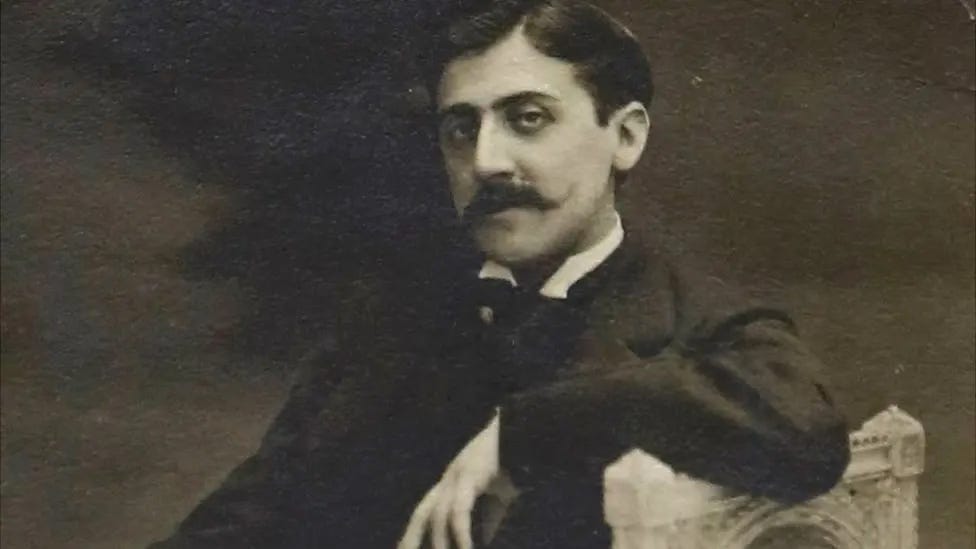
In 2016, my attention started to go off the rails. News cycles were becoming more chaotic because of Trump, but I couldn’t tell at the time if he was a catalyst or a symptom. I was on social media, particularly Facebook, many times a day.
Starting in the 2000’s, I created social media accounts for my ensemble So Percussion. Before this time, promoting a career in classical music by yourself was nearly impossible. Institutions, competitions, press outlets, and – impossible as it is to believe now – record labels decided careers. We benefitted from the attention and support of some of those institutions like the New York Times and The Yale School of Music. For a decade or so, old and new media cooperated in an uneasy truce.
The exponential growth in services like Facebook at that time was exhilarating. People were having fun posting content and getting instantaneous reactions from all over the world for the first time. During that exciting period in my 20s, it was easy to tell myself that it was my job to monitor those services. I came to see engagement with our content as a measure of how well I was managing my administrative responsibilities.
I also felt like I was building a personal identity or brand online. I started a blog to publish articles and program notes, and it performed surprisingly well (far better than my current Substack, which admittedly I have done little to coax along).
My brain was not prepared for the infinite scroll. I didn’t realize what it was, or the addictive behaviors it was encouraging. Gradually, what I now unaffectionately call “reading the internet” turned into a massively time-consuming activity, particularly once I had a smartphone. This is a phenomenon most of us are aware of now, but at the time I was struggling to pinpoint it.
Other than realizing that I was wasting a lot of my time – and that a lot of other people were, too – I started to notice that I couldn’t finish reading books. I hadn’t yet designed any of my current coping tools like turning off notifications, so my phone was pinging me constantly. Every time I sat down to read, I couldn’t muster the absorption to turn even a few pages.
This coalesced into an existential crisis for me, so at about that time in my mid-thirties, I resolved to read some ambitious books.
I was born in 1979, which is the perfect vantage point from which to view the personal computer/device revolution. I wrote essays in high school by hand (as I am also doing for the first draft of this essay). I completed my college essays by feeding the forms through a typewriter. I experienced vast stretches of unrelieved boredom as a child, much of which I tackled by reading books (and also plenty of tv and video games). I listened to music on a cassette Walkman. My friends and I wandered the neighborhood for hours on weekends, with instructions to be home “by dinner.” Whichever house we ended up at, the presiding parent would call around to the other parents to let them know where their kids were.
As a child, I would hole up in my room to read, often at the expense of other important activities like assigned homework. This compulsion, accompanied by a relatively fast reading speed, served me well for most of my life. I got by in school, despite a spotty participation record. I read a lot of books.
My ability to read with absorption was often facilitated by a lack of other compelling options. But, I was also the first generation to have the Nintendo Entertainment System, and I watched endless hours of TV, which were the smartphones of 1988.
The Practice
With those eras behind me, and with my early-midlife attention crisis at hand, I resolved to make a practice out of reading. This meant hard work, and I knew that if the iPhone was within reach, I was never going to pick up Infinite Jest just for the heck of it. (During Covid, I tried using a flip phone exclusively for about a year. I was thwarted when they required me to have an app installed to verify my test results).
That weighty tome was my first project. While I methodically made my way through it, I decided this kind of reading would be a practice, not an occasional recreational activity. I was familiar with this paradigm as a musician: achieving steady, regular progress, doing it even when you don’t feel like it, staying focused on the larger goal.
Mixing media was very effective. Infinite Jest famously “starts” out of sequence in the narration, so it is initially hard to follow. I made the cost-inefficient decision to buy it in hardcopy, e-book, and audiobook, and to toggle around between them. The paper book was always the most pleasurable format, but the audiobook allowed me to walk and drive while reading, and the Kindle was easier to travel with.
I discovered that my best reading time was first thing in the morning with coffee. Thirty minutes of reading seems insignificant in a 1000-page novel, but at the leisurely pace of ten pages a day, that’s Infinite Jest inside of four months even with some days off.
I settled upon 30-minute sessions because that was a doable daily chunk, but I found that it took the first ten or fifteen minutes for my mind to relax and accept the focused activity. This meant that an average 30-minute session might consist of only 15 minutes of relaxed absorption. But, more often than not, once I was in that state, I could continue for another 30 minutes or more if time allowed. If it didn’t, the daily habit conditioned my mind to expect this concentrated effort every day, and to deal with it.
In that first 10 or 15 minutes, sometimes things went smoothly, but often I had to re-read paragraphs because my mind wasn’t yet in the flow of the reading. Observing the 30-minute rule meant that even if I spent the whole time trying not to be distracted and only got through a few pages, that was ok. It was like a meditation in that sense: if the whole session was a struggle and I barely read anything, I would still benefit from the time spent in a focused activity.
Gradually, my endurance increased and my focus returned. I progressed from Infinite Jest to Cervantes, Joyce, Mann, and Melville. All the while, Marcel Proust’s In Search of Lost Time lingered as the ultimate test of my fortitude: a seven novel series that alternates between comical portraits of ridiculous French aristocrats and gorgeous, voluminous observations about the human condition. I finished it this past January, just over three years since I started it.
The Transformation
The brilliant thing about this odyssey over the last ten years is that none of the works was quite what I thought they would be based on their reputation. Don Quixote, after all the famous windmill-tilting, turns into a piece of symphonic meta-fiction where the characters must grapple with fictional versions of themselves because their earlier exploits have been published and widely read in their world.
Infinite Jest has a complex structure, but also a deeply compassionate perspective. Ulysses was – well Ulysses, but deeply rewarding nonetheless, more of an experimental poem than a novel. Thomas Mann’s The Magic Mountain played with time expansion and compression in ways I had never experienced and was as much a book of philosophical dialogues as narrative. Moby Dick has whole chapters of facts about whales and whaling that I initially found off-putting, but they immerse you into the narrator’s world on the ship. After reading Gertrude Stein’s Tender Buttons and Virginia Woolf’s Diaries, I also realized that I was especially interested in that early modernist period.
For Proust most of all, my initial attitude of “here comes the big one” was constantly redirected by the author’s subtle and humorous digressions. In many ways that largest of books is about the smallest of things - the fleeting sensory experiences that come unbidden, the way they transport us into other moments of experience, the realization that life is a barely connected braid of those tiny moments.
I wish these works were promoted differently. Like: “it’s not what you think; I can’t explain it to you, you will just have to try reading it for yourself.” These books read you: their perspective is too capacious to be filtered through any one person’s reading experience.
Over the last three years, the practice was mostly given over to Proust with a few breaks to read other novels (Wuthering Heights is the most sadistic book about the most dysfunctional people that I’ve ever read. I can’t imagine how anybody thinks it is romantic). These were my mornings with Marcel. We spent that first ten minutes of frayed attention together while he coaxed me into deep conversation and reflection. There are many paradoxes in his work, one of which is that an author who wrote a nine-hundred-word sentence has also made each word indispensable. The prose isn’t challenging to read, but it is so thick with meaning that ten pages in thirty minutes was the perfect pace. There was so much to think about, and there were so many passages to underline, in each ten-page chunk of text.
I spent an enormous amount of time with this author: 4,200 pages over seven volumes, roughly 420 reading sessions of 30 minutes each, 210 hours of reading. Although fictional, it was always told from the same narrator’s autobiographical perspective from childhood until his early 50s (close to my age now). It is the most intimate relationship with an author that I have ever had. When I started Swann’s Way, I read online about other people who started back at the beginning after finishing the final volume and kept reading the cycle over and over again. That seemed insane to me when I still had thousands of pages to go.
But now I get it. I miss him. It felt like every day, one of the smartest and most sensitive people I knew would sit with me and open a new reflection on art, music, psychology, queerness and sexuality (this has to be one of the greatest LGBT novels before the modern gay rights era), death, non-duality, and every aspect of the human condition.
I would never have finished it recreationally. It took a supremely pleasurable kind of work. I did not try to use it as a substitute for mindless activity when I was tired – Proust demanded my complete attention. By giving it to him, I gradually reclaimed the brain I remembered having before the internet existed.
I even reclaimed a bit of joy by using the internet as a resource. I watched YouTube videos of talks by Proust scholars, read other people’s blogs about their journeys, and subscribed to r/Proust on Reddit. I settled into a balance, confident that my offline habits were supplying me with enough focus to enjoy online benefits (I still needed to delete my Reddit account because I really can’t do any algorithmically determined infinite scroll. Same with Substack Notes).
The steady practice supplied confidence that I would finish. By doing the reading in the morning, it also set the tone for my day. No email intimidates you when you have already read 10 pages of Proust.
The last stage of my Proust project is to go back through all my underlined passages and assemble them in one place. The experience of reading it changed me, and I am tempted to go back through it all again. But there is so much else to read, and I will never get to it all.
I had not a dissimilar experience with him around the same time, motivated not by a desire to get off my phone (although that also remains a theme) but by the sudden death of a family member and a need to kind of disappear for a bit. And what a magnificent companion he was in grief too. I also miss him. (Beautiful piece, thank you!)
Beautiful to read about the self-kindness away from the infinite scroll. Thank you.